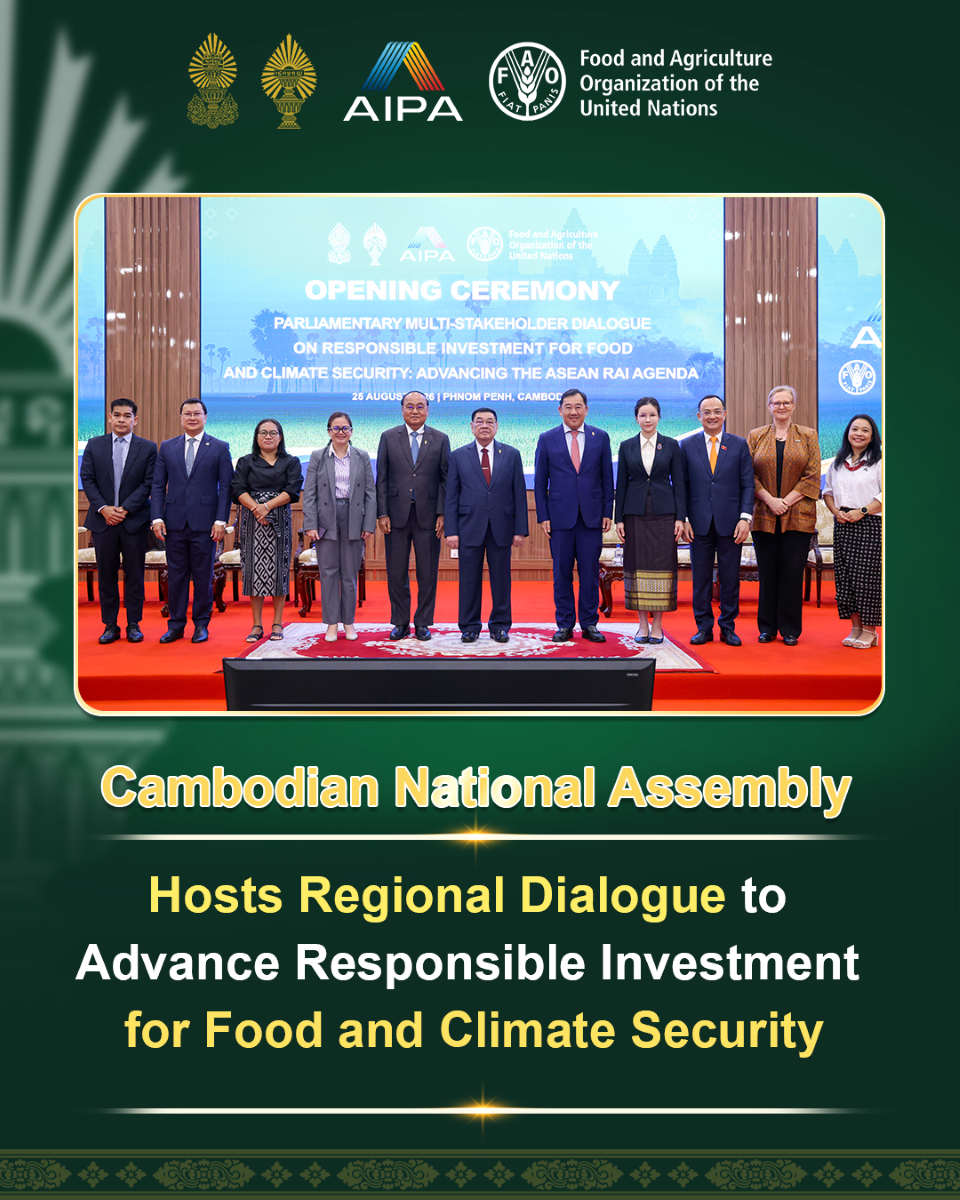
Phnom Penh, 25 August 2026 — The National Assembly of the Kingdom of Cambodia on Tuesday hosted the opening of the Parliamentary Multi-Stakeholder Dialogue on “Responsible Investment for Food and Climate Security: Advancing the ASEAN RAI Agenda” at the National Assembly Palace.
The event brought together leaders and members of the Senate and National Assemblies from ASEAN countries, representatives of relevant ministries and institutions, development partners, the private sector, academia, civil society, and senior officials of the National Assembly of Cambodia.
The two-day dialogue, held on 25–26 August, aims to strengthen parliamentary understanding and multi-stakeholder cooperation on food security, climate resilience and responsible investment, while identifying opportunities for coordinated parliamentary action in Cambodia and across ASEAN.
Hosted by the National Assembly of Cambodia in collaboration with the Senate of Cambodia and the ASEAN Inter-Parliamentary Assembly (AIPA), with support from the Food and Agriculture Organization of the United Nations (FAO), the event reflects the strong commitment of Samdech Maha Rathsapheathika Thipadei Khuon Sudary, President of the National Assembly of Cambodia, to promoting people-centred regional cooperation for food security, climate resilience and sustainable development.
Speaking on behalf of Samdech Khuon Sudary, Hon. Kittisethabindit Cheam Yeap, First Vice-President of the National Assembly and Chairman of the Cambodian AIPA National Group, officially opened the dialogue.
Hon. Cheam Yeap warned that climate change and food insecurity are no longer future threats, as extreme weather and environmental degradation are already disrupting agricultural production and food systems across Southeast Asia.
He said investment in food, agriculture and forestry must be economically viable, socially equitable and environmentally sustainable. “We cannot afford investments that extract short-term profits at the expense of our long-term survival,” he said.
Hon. Cheam Yeap emphasised that parliaments must translate the ASEAN RAI Guidelines into concrete national action through their legislative, oversight, budgetary and representative functions.
He also called for cooperation among parliaments, governments, the private sector, research institutions and local communities. The dialogue is expected to produce practical recommendations that could contribute to AIPA’s engagement with ASEAN leaders.
In his welcome remarks, Hon. Santibindit Loy Sophat, Chairman of the National Assembly Commission on Planning, Investment, Agriculture, Forestry, Fisheries, Rural Development, Environment, Water Resources and Meteorology, highlighted regional solidarity in addressing food insecurity and climate change.
“Climate change is no longer a distant threat; it is an immediate reality affecting our societies, economies, agricultural systems, and the daily lives of our people,” he said.
He noted that agriculture remains a foundation of Cambodia’s economy, while the country’s fertile land, water resources and strategic location provide strong potential for sustainable agriculture, agro-industry and regional market connectivity.
Hon. Loy Sophat proposed three guiding principles for responsible investment: responsibility, resilience and solidarity. Such investment, he said, should improve farmers’ livelihoods, create jobs and protect the environment.
He also encouraged greater support for agricultural and agro-industrial SMEs and investment in technology, infrastructure, processing and storage. “Our goal is not only to produce enough to meet domestic demand, but to produce with quality, safety, standards, and competitiveness,” he said.
H.E. Dith Tina, Minister of Agriculture, Forestry and Fisheries, said the dialogue provides an important mechanism for translating responsible agricultural investment into practical and lasting benefits for farmers, consumers and rural communities.
He outlined a vision for an agricultural sector that is economically viable for farmers, responsive to consumers, environmentally responsible and socially beneficial.
Amid growing climate threats, the Minister emphasised the need to improve not only agricultural output but also quality, market access and resilience. “We must move from producing more to producing better,” he said.
He added that Cambodia must deliver trusted, high-value food supported by strong market linkages, greater climate resilience and respect for the environment.
“Responsible investment, backed by sound legislation and parliamentary oversight, is the engine of this transformation,” he said.
In his pre-recorded remarks, H.E. Dr. Chem Widhya, Secretary-General of AIPA, said the ASEAN RAI Parliamentary Implementation Framework 2024–2030 provides parliamentarians with a practical roadmap for advancing responsible investment across the region.
Through legislation, budgeting and oversight, he said, parliaments can ensure that investment in food, agriculture and forestry supports food security, climate resilience and national development priorities.
“Let us be clear, no parliament can advance this agenda alone,” he said. “Advancing responsible investment is a collective responsibility that calls for strong partnership among parliamentarians, government institutions, the private sector, academia, civil society and local authorities.”
Ms. Rebekah Bell, FAO Representative in Cambodia, emphasised the importance of ensuring that agrifood investment is responsible, inclusive and beneficial to farmers and communities.
“We need investment in the agrifood sector. But it matters how we invest, where we invest, and who benefits from that investment,” she said.
She added that responsible investment should create opportunities for farmers and businesses while protecting natural resources and strengthening climate resilience.
Ms. Bell also linked the dialogue to the Cambodia Agriculture Forum and Exhibition 2026, scheduled for 23–25 October under the theme “Investing in Cambodia’s Agrifood: Partnerships, Value Addition and Innovation.”
She encouraged participants to focus on practical action and consider what stakeholders could do differently, better and collectively to achieve greater impact.
The ASEAN RAI Guidelines were adopted by ASEAN ministers in 2018 to promote socially equitable, economically viable and environmentally sustainable investment in food, agriculture and forestry.
The ASEAN RAI Parliamentary Implementation Framework 2024–2030, adopted at the 45th AIPA General Assembly in Vientiane in 2024, guides parliamentarians in advancing responsible investment through legislation, budgeting, oversight and representation.